
Which Nasolabial Fold Filler Brand Lasts the Longest? A Deep Dive into Why Hyaluronic Acid Leads in Long-Term Value
As you enter your 30s, one of the most concerning skin issues for many people is “deep nasolabial folds” (smile lines), which can make the face look tired and older than it actually is. Restoring volume with dermal “fillers” has become a popular solution for quickly regaining a youthful appearance. However, the most common questions doctors receive from patients are: “Which nasolabial fold filler brand lasts the longest?” and “Why does Hyaluronic Acid (HA) remain so popular for long-term value?”
This article delves into the answers using scientific data and medical research to help you choose the best and most cost-effective option for your face.
Deep Dive into Medical Research: Hyaluronic Acid (HA) Excels in Long-Term Stability
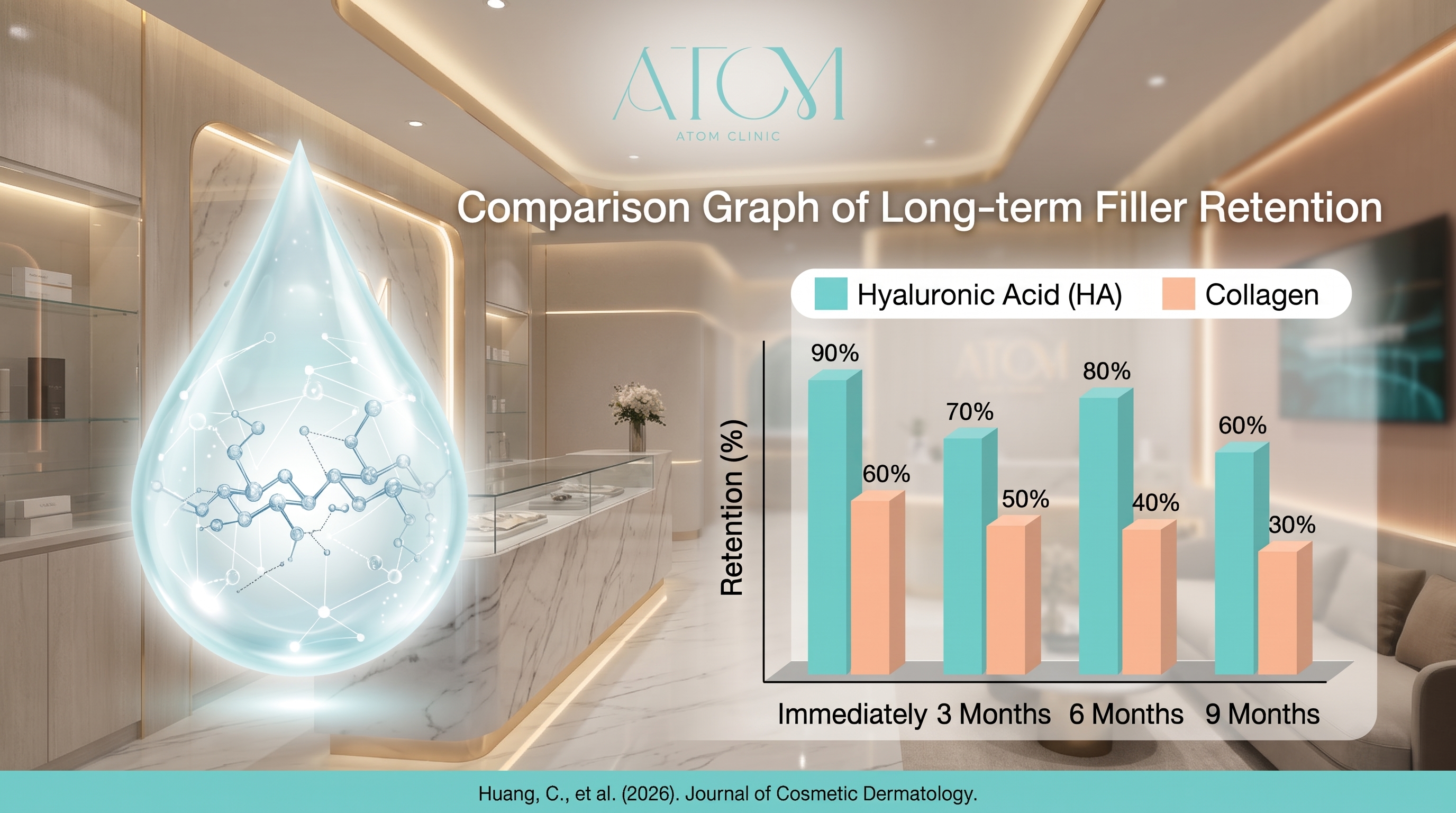
According to a recent clinical studya Prospective Randomized Controlled Trial published in the globally recognized Journal of Cosmetic Dermatology (2026)researchers compared the efficacy of Hyaluronic Acid (HA) fillers and Collagen fillers in patients with moderate-to-severe nasolabial folds.
The results from the 6-month follow-up clearly demonstrated a difference in “long-term stability and value,” as detailed below:
1. Shape Retention and Durability at 6 Months (Longevity)
During the first 3 months, both HA and collagen fillers reduced the depth of nasolabial folds equally well. However, by month 6, the study found that the HA filler group maintained the length, width, and depth of the nasolabial folds significantly better statistically. Meanwhile, collagen began to break down faster due to the repetitive movements of daily facial expressions.
2. Viscosity and Skin-Lifting Support (Rheological Properties)
The scientific reason HA lasts longer lies in its physical properties, specifically a higher G' (Elastic Modulus) and greater Cohesivity. When injected into the nasolabial foldsa high-movement area known as a Dynamic Zone (used when smiling, speaking, or chewing)HA can withstand compressive forces and act as a firm structural support for the skin without breaking down easily.
Comparison of Results: HA vs. Collagen for Nasolabial Folds
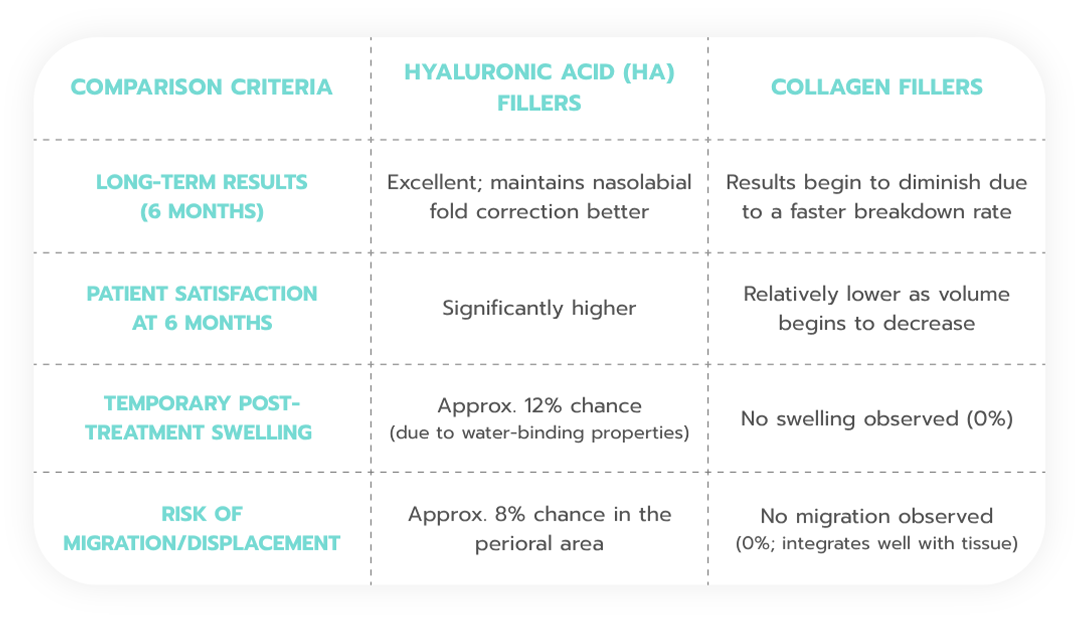
To give you a clearer picture when evaluating value, here is a summary table comparing the effects and post-injection results of both substances as reported in the study:
Which Nasolabial Fold Filler Brand is Best? Top Long-Lasting Recommendations
If you have decided to prioritize long-term value, durability, and strong lifting support for your nasolabial folds, here are the large-molecule, high-stability HA fillers approved by the Thai FDA that doctors recommend:
- Restylane Lyft (Sweden): The popular filler featured in this global study. It stands out for its NASHA technology, offering a firm gel texture that holds its shape well with high lifting capacity. It is ideal for deep injections onto the bone to effectively lift sagging nasolabial folds, lasting approximately 1218 months.
- Juvederm Ultra Plus / Voluma (USA): Ultra Plus excels in plumping volume, making it ideal for very deep nasolabial folds. Voluma stands out for its high density, superior lifting support, and slow breakdown rate, lasting up to 1824 months.
- Belotero Intense (Switzerland): A dense filler with high elasticity, excelling at naturally filling deep folds caused by tissue volume loss. It lasts approximately 1218 months.
Conclusion: How to Choose the Most Cost-Effective and Safest Option?
Research clearly concludes that Hyaluronic Acid (HA) remains the “Gold Standard” for correcting nasolabial folds in terms of value and long-term result retentioneven though it may cause slightly more temporary swelling during the first 13 days due to its water-binding properties.
However, the most critical factor in ensuring your filler lasts long, looks natural, and is completely safe is not just the brand you choose, but the “doctor's technique.” A skilled physician must know how to design and place the filler in the correct skin layers (such as combining deep bone-level support with subcutaneous fat layer placement). Most importantly, always choose authentic, verifiable fillers.


